Monday, September 30, 2013

Taylor Pea Sheller Review

Today, I am going to review the "commercial pea sheller" known as the Taylor Pea Sheller. But before I begin this review, while the Taylor Pea Sheller is often referred to as a commercial pea sheller, it also perfectly suitable as a residential pea sheller. In fact, the Taylor Pea Sheller is larger and more reliable than other residential and light commercial pea shellers and it features a 1/3 HP motor. If you have a large home garden or will be shelling a substantial quantity of peas, the Talyor Pea Sheller is the preferred pea sheller for you. For smaller quantities of peas. the Mr. Pea Sheller is a more appropriate electric pea sheller.


What you are getting with the Taylor Pea Sheller is a lot of flexibility. Its small size makes the Taylor Pea Sheller highly mobile. You can take it with you to the kitchen, living room, or on an outside patio. Heck, you can take it to the field, as long as you can get a power source and ensure that the unit (and power source) are protected from moisture. Once you select a location to use your Taylor Pea Sheller, you will quickly discover that it can shell 3 to 4 bushels of peas per hour. The Taylor Pea Sheller is excellent for shelling black eyed peas, crowders, lady fingers, white acres, butter beans, and English peas.

Corn Husking with the EZ Chopper Cutting Board


Corn husking can be quite easy if you have the right tools. One of the essential tools that will make your corn husking easier is the EZ Chopper Cutting Board. The EZ Chopper features a cleaver holder that rotates on a food safe cutting board. When attached to a cleaver, the EZ Chopper allows you to efficiently and easily cut both ends of the corn for further corn processing. In addition to being a corn cutter, the EZ Chopper slices all kinds of other fruits and vegetables. It's ability to quickly process corn and other fruits and vegetables make the EZ Chopper a must have corn cutting tool.

But if you are looking to efficiently process your corn, do not stop with just the EZ Chopper. Once you have cut your corn ends with the EZ Chopper, use the the EZ Creamer Corn Cutter to complete your corn processing. The EZ Creamer corn creamer machine is an amazing tool that easily shucks, cuts and creams corn in seconds. It is an all in one corn sheller, corn shucker, and corn cuter.


Monday, September 23, 2013

A Quick Overview on Harvesting Black Walnuts


Experts predict that hazelnuts, because of their versatility, will provide many lucrative opportunities for nut growers and processors.  Hazelnuts are very popular in trail mixes. Additionally, hazelnut by-products can be used in a wide array of food products, including edible oils, spreadable nut butters, nut flours, and confections.  In addition to uses in food products, hazelnuts may be effectively used as feedstock in a bioenergy environment.  Given the hazelnuts' potential for economic enrichment, it is important for small growers to know how to efficiently harvest the nuts. 

Black walnuts should be harvested during the the fall, when they reach maturity. When mature, the nut hulls turn from yellowish to black. The hull will be soft to the touch and when squeezed your finger should leave an indentation on the hulls. Some people prefer to harvest black walnuts off the ground while others harvest off the tree. Harvesting off the tree may yield maximum quality.

Once you have picked your black walnuts, you should start hulling them. One of the commonly utilized hulling methods is stomping the nuts until the hull is removed. Be wary of the hull juice, as it will stain anything that it comes into contact with, including the cement, your clothing and your hands. The stain is extremely difficult to remove from your hands and impossible to remove from your clothing. So try not to get it on you. After you have removed the hulls, wash the nuts in water and remove dirt and debris. Take notice of any nuts that float during the washing process - they are rotten and should be thrown away. After washing allow the nuts to dry for several weeks in a cool dry space. Lastly, you will need to crack them. Do not even think about using a hammer or vice. The black walnut cracking tools are too slow and unreliable. Invest in a  black walnut cracking machine such as the Hunt’s Walnut Cracker or the Drill Cracker.

Drill Cracker
Be sure to store your black walnuts in a freezer to preserve freshness.

A Retiree's Joy of Harvesting Black Walnuts

Friday, September 20, 2013

The Holt's Nut Wizard: Much More than a Nut Picker Upper


The other day, I was having lunch with my friend Kerry and his wife, Laura. Kerry is the owner of Lawn Gardening Tools, a website specializing in - none other than lawn gardening tools (you guessed it). Anyway, we are sitting in this restaurant and Kerry was describing this amazing nut picker upper tool called the Nut Wizard. The odd thing was that the Nut Wizard picks up apples, golf balls, ammo shell casings, pine cones, and all kinds of nuts.

So anyway, as I am listening to Kerry enthusiastically talk about the Nut Wizard,


I could not help but think to myself: "Nut Wizard. The name is an oxymoron. I mean how can you be both a nut and a wizard?" So I ask Kerry why call the nut wizard a nut wizard, when it does so much more than being the ultimate nut picker upper? Heck, it picks up golf balls. It's an apple picker upper. The so called Nut Wizard picks up ammo shell casings for goodness sake! It simply does not make sense to call it a nut wizard or a nut picker upper when it picks up so many other things.

Kerry's response was "too bad the Nut Wizard cannot pick you up and take you outta here!" Kerry let me know that the Nut Wizard isn't just called the Nut Wizard - it, like me, is called all sorts of names. "It's known as a nut roller, a nut gathering tool, the nut gatherer, nut picker, nut roller, gum ball picker, nut picker-upper, basket nut tool, nut grabber, yard roller, walnut roller, walnut tool, nut tool, lawn sweeper, walnut rake, lawn whisk, nut collector, acorn rake ... you get the picture"" Kerry asked. And just when I was about to say never mind, Laura comes in to add more names to the list: "sweet gum ball rake, acorn gatherer, acorn picker upper, pecan picker upper, walnut picker upper, pecan retriever, and sticky ball collector."

"Enough," I exclaimed. "I get it. You all are saying the Nut Wizard can pick up anything smaller than me." Kerry, looking pleased that I conceded that the Nut Wizard is the best nut picker upper in the world, said "Exactly, my Nut Wizard is the world's best nut picker upper and it can pick up anything smaller than you."

You should have seen Kerry's face when, just at that moment the waitress came with the check and I told him, "Great, then you and your Nut Wizard can pick up the tab, Kerry!

Monday, September 16, 2013

The Basics of Home Harvest Automation: Part 2 - Corn

Corn is among the most popular vegetables in the United States.  (Remember tomatoes are a fruit.)  But harvesting corn -  that is, getting corn from the field to the dinner plate, can be a challenge.  So today we are going to review the best way to harvest corn.


Timing Is Everything (Almost)

The very first step in harvesting corn is knowing when is the appropriate time to start harvesting. The window for harvesting most corn varieties is small so it is important to get the timing right.  There are several cues that you can go by to ensure that it is time to harvest.  First, the corn silks will dry up right before it is time for harvesting.  So if the corn silks are not dry, you automatically know that it is not yet time to harvest.  Secondly, if you check the corn ears, you can get a better idea whether it is ready to be harvested.  When the corn ears are fully expanded, the corn is read for harvesting.  The corn ears should have a rounded shape - not a pointed shape.  Finally, if you need further assurances that your corn is absolutely ready for harvesting, you can pull back the husk and ascertain whether the ear looks well filled.  You can prick a kernel of corn with a fingernail to see if the corn liquid is watery or milky white.  If the corn liquid is white, the corn is not ripe and therefore not ready for harvesting.  On the other hand, milky cork liquid indicates you are absolutely ready for harvesting. 


The Need for Speed

Once you have picked your corn, it is best to eat or store it as quickly as possible.  This will ensure that the corn does not have time to deteriorate, as the deterioration process starts immediately after picking.  Deterioration involves a process whereby the corn's natural sugars are converted into starch.  So if you are not going to immediately eat your corn you will need to slow down the deterioration process by blanching the corn.  Blanching simply means placing the corn in boiling water for about five minutes.  Once you have blanched the corn, it is imperative that you quickly process your corn for storage and there are a number of tools that can help you in that regard.


Lee's Corn Cutter

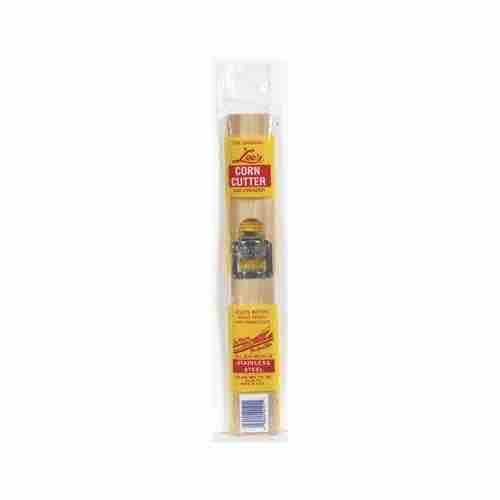
One of the most helpful corn processing tools is a corn cutter gadget such as the Lee's Corn Cutter.  The Lee's Corn Cutter and Creamer is the best wood corn cutter on the market.  And it is much less expensive than a typical electric corn creamer.  It utilizes a sharp, specially engineered corn cutter blade that is capable of cutting corn kernels cleanly or cream style.  Alternatively, you may find the Thomas Corn System, an electric corn creamer, to be more convenient and faster.  Electric corn creamers are a convenient way to handle the almost all of the corn processing steps, including shucking the corn.  Electric corn creamers typically require the use of a household drill and involve inserting the corn cob into a specially designed plastic tube where the corn is spun.  This spinning process is separately used to remove the shuck and corn kernels.  

Once you have processed your corn, you should now store it.  Because corn loses it sugars at a much slower pace when stored at lower temperatures, we refrigerating your corn.  For longer term storage, the best option is freezing in a vacuum sealer or canning.  If you are not a home canner, though, you will obviously need to buy canning supplies.
Trust us when we tell you, you will enjoy your corn harvest by taking the above steps to make sure it remains fresh. 

.